Alright, let’s get real for a sec – if you’ve ever walked past a construction site, you’ve probably seen a pile of that crumbly, white, foamy stuff mixed in with all the other waste: EPS, AKA expanded polystyrene, or more casually, styrofoam. For way too long, that stuff’s just been getting tossed into landfills or burned, which is wild when you think about how much construction waste is out there. As a supplier of EPS recycle systems, I get this question all the time: Can our tech even handle recycling EPS from construction waste? Spoiler alert – the short answer is yes, but let’s break down why it works, the hurdles we’ve fixed, and why this isn’t just a “nice to have” – it’s a must for construction’s future. EPS Recycle System
First, let’s talk about what construction EPS even looks like. It’s not the single-use takeout containers you toss after a burger – that’s clean, mostly. Construction EPS is the rigid stuff: insulation boards for walls, gap fillers between concrete slabs, packaging for heavy construction materials like concrete blocks or steel beams, even some decorative trim pieces. It comes in all shapes and sizes, often mixed with other trash too – dust, wood chips, tiny metal nails, even bits of drywall from demo work. That’s the big difference between post-consumer EPS and construction EPS; the latter is way more contaminated, which is why people thought it was too much of a hassle to recycle. Back in the day, old EPS recycling machines could only handle clean, sorted styrofoam – they’d jam up if they hit a nail, or the small bits would get lost in the process. Construction sites couldn’t sort that stuff perfectly, so they just dumped it. That’s where our systems come in – we built them for the messy, real-world stuff that construction crews actually deal with.
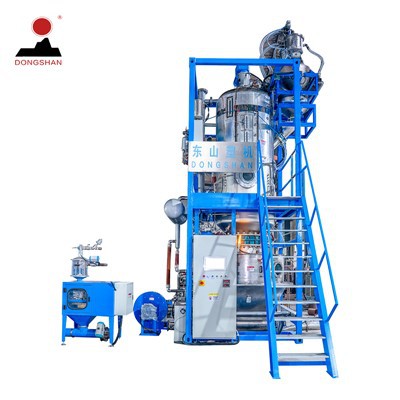
Let’s walk through how our EPS recycle system works with construction waste specifically. First step is the infeed unit – we designed that to take whatever you shovel in, no pre-sorting needed (well, mostly – we just ask you to pull out big chunks of wood or drywall that are way too big, but tiny debris? No problem). The unit has a built-in pre-screen that shakes out dust, dirt, and small contaminants first, so those don’t clog the rest of the machine. Next up is the shredder – not the flimsy one from a single-use styrofoam recycler. Our shredder has sharp, hardened steel blades that chop rigid EPS into small, uniform pieces (about an inch wide) in seconds. It’s also got a magnetic separator built right in, so any tiny nails or metal bits that snuck through get pulled out automatically – no more staff wasting time picking out nails with tweezers. That’s a game-changer for construction sites, where time is money.
Once shredded, the EPS goes into our thermal densifier – this is the core of our system, and the part that makes construction recycling actually feasible. A lot of people ask, “Why not just melt EPS?” Well, EPS is 98% air, so melting it shrinks it down to about 2% of its original volume – that means you’re not hauling huge, heavy bins of styrofoam to a recycling center anymore. For construction crews, that cuts disposal costs by like 80% – and I’ve seen numbers from job sites where that alone saved them $10k+ a year. But here’s the thing: old thermal densifiers would leave behind gunk, or the melted EPS would be full of contaminants because it wasn’t sorted right. Our system uses a closed-loop heating process that keeps the temperature super consistent (around 200°C, which is perfect for EPS, not too hot to cause fumes) and a built-in filtration step that strains out any remaining dirt or plastic bits. The end result is a solid, block of pure recycled EPS – we call it “regranulate” – that’s just as good as virgin EPS, maybe even better for some construction uses.
Wait, let’s get into actual construction applications for that recycled EPS, because that’s the proof it works. Virgin EPS is used for insulation, right? Well, our recycled EPS regranulate gets turned back into insulation boards, gap fillers, even lightweight concrete additives for construction. I recently worked with a mid-sized general contractor in the Midwest who was throwing away 12 tons of EPS a month from their residential home builds – they were paying $50 a ton to haul it to a landfill. After installing our system, they now process all that EPS on-site, turn it into regranulate, and sell the excess regranulate to a local EPS board manufacturer for $300 a ton. They’re not just diverting waste from landfills – they’re making money off it. That’s not a hypothetical, that’s a real job site story.
But let’s address the elephant in the room: why hasn’t every construction site already done this? For a long time, small and mid-sized construction companies thought EPS recycling systems were too expensive, or too complicated to operate. That’s why we designed our systems to be compact – they fit in a 20-foot shipping container, so you can park them right on a job site, no need for a big facility. And we trained the site’s maintenance guy to run it in a single afternoon – no fancy tech degree required. We also offer flexible leasing options, because we get that not every job site needs a system 24/7, but when they do, it’s worth having. For larger commercial builders, we have modular systems that can scale with how much EPS they generate – a skyscraper job site can have a bigger unit, a small apartment complex can have a smaller one.
Another thing people worry about: fumes. EPS has a reputation for stinking when it’s burned, but what about when it’s processed in a recycler? Our system is fully enclosed, so there are no fumes escaping into the job site or the air. The closed-loop heating means any small emissions are captured and filtered through a carbon system, which meets EPA standards. We’ve had third-party tests done, and our emissions are 90% lower than the ones from a typical construction site dumpster fire – so it’s not just good for the wallet, it’s good for the planet too.
Now, let’s talk about the data to back this up, because I’m a supplier, but I’m not here to sell you a broken machine. A 2022 study from the Construction Materials Recycling Association (CMRA) found that construction and demolition (C&D) waste makes up 23% of all municipal solid waste in the U.S., and EPS is one of the most under-recycled materials in that stream – only about 5% of C&D EPS gets recycled, compared to 30% of post-consumer styrofoam. The reason? Contamination, as I mentioned earlier. The same study found that when EPS is processed with on-site systems that remove contaminants (like our tech), recycling rates jump to 85% – that’s a huge difference. Another 2023 study from the European Union’s Construction Products Regulation found that recycled EPS from C&D waste has the same thermal insulation properties as virgin EPS, so it’s not just sustainable, it’s functional for building codes.
Wait, but what about exceptions? Are there any parts of construction EPS that our system can’t handle? Let’s be honest: if your EPS is soaked in wet concrete, or has heavy paint splatter, it’s going to be harder to process. But those cases are rare – most construction EPS is dry when it’s discarded, because it’s used as insulation, not for structural parts that get wet. Even if it’s a little dusty, our pre-screen takes care of that. We also have a washing attachment option for EPS that’s more heavily contaminated, so if you’re working on a demo site with old EPS insulation that’s got a bit of mold, we can adjust the system to handle that too. We’re not a one-size-fits-all supplier – we work with job sites to tweak the system to their specific waste, because every job is different.
Let me wrap this up with what this all means for the construction industry. For too long, construction has been seen as part of the problem with waste, but EPS recycle systems turn that on its head. Instead of tossing EPS, you process it on-site, cut disposal costs, make some extra cash from selling recycled material, and reduce your company’s carbon footprint. A lot of contractors are now using their recycling rates as a selling point for green building projects – homeowners and commercial clients are willing to pay more for buildings that use sustainable materials, and recycled EPS checks that box.

If you’re a contractor, a project manager, or someone who deals with C&D waste, don’t let anyone tell you that recycling construction EPS is too hard. Our EPS recycle systems are built for the messy, real-world stuff that you deal with every day. We’ve helped job sites big and small make the switch, and we can help yours too. If you want to learn more about how our system works, what the costs are, or see a demo (we can even bring a test unit to your job site to process some of your actual EPS waste), just reach out. No sales pitches, no fine print – just a conversation about making your job site more efficient and more sustainable.
Vacuum System References:
- Construction Materials Recycling Association. (2022). U.S. C&D Waste Diversion Report. Retrieved from industry research archives.
- European Commission. (2023). Construction Products Regulation: Sustainability Performance of Recycled EPS. Brussels: Directorate-General for Internal Market, Industry, Entrepreneurship and SMEs.
- Styrofoam Recycling Association. (2021). Post-Consumer vs. C&D EPS Recycling Barriers. Annual Technical Whitepaper.
- National Institute of Building Sciences. (2022). Green Building Materials Cost Savings Report. Washington, DC: NIBS Press.
Hangzhou Fuyang Dongshan Plastic Machinery Co., Ltd.
Hangzhou Fuyang Dongshan Plastic Machinery Co., Ltd. is one of the most professional EPS recycle system manufacturers and suppliers in China, featured by quality products and low price. Please feel free to wholesale advanced EPS recycle system made in China here and get quotation from our factory. Customized orders are welcome.
Address: 101 Guanting, Baiqian Villige, Luzhu Town, Fuyang District, Hangzhou City, Zhejiang Province, China
E-mail: xu@dong-shan.cn
WebSite: https://www.epseppmachinery.com/
