Hey there! I’m a supplier of industrial robots, and today I wanna chat about the communication interfaces of these cool machines. Industrial robots have become a big deal in manufacturing and various industries, and understanding their communication interfaces is super important for making them work well in a production setup. Industrial Robot

Let’s start with the basics. Communication interfaces in industrial robots are like the bridges that allow these robots to talk to other devices, systems, and even humans. They’re crucial for getting the robots to perform tasks accurately and efficiently. There are several types of communication interfaces commonly used in industrial robots, and each has its own features and benefits.
Ethernet Interfaces
One of the most popular communication interfaces is Ethernet. Ethernet is like the workhorse of the digital communication world. It’s fast, reliable, and widely used in industrial settings. Many of the industrial robots we supply are equipped with Ethernet interfaces.
With Ethernet, robots can connect to local area networks (LANs) and communicate with other devices such as programmable logic controllers (PLCs), human – machine interfaces (HMIs), and computers. This connectivity allows for real – time data exchange. For example, a robot on an assembly line can send data about the number of parts it has assembled to a PLC, which can then adjust the production process accordingly.
Ethernet also supports remote monitoring and control. Using an Ethernet connection, operators can remotely access the robot’s control system from a control room or even from a different location. This is great for troubleshooting and making adjustments without having to be right next to the robot. It saves time and keeps the production running smoothly.
Profibus
Profibus is another well – known communication interface in the industrial robot world. It’s a fieldbus system that’s commonly used in manufacturing environments. Profibus has two main variants: Profibus DP (Decentralized Peripherals) and Profibus PA (Process Automation).
In our experience, Profibus DP is often used for high – speed communication between the robot and other devices on the factory floor. It can handle a large amount of data quickly, which is perfect for applications where the robot needs to communicate with multiple sensors and actuators in real – time. For instance, in a robotic welding application, the robot can use Profibus DP to communicate with the welding power source, sensors that detect the position of the workpiece, and other equipment.
Profibus PA, on the other hand, is more focused on process automation. It’s used in applications where the robot is involved in continuous processes, such as chemical manufacturing or food processing. It provides a reliable way to communicate with process – related devices and ensure that the production process is stable and efficient.
CANopen
CANopen is a communication protocol based on the Controller Area Network (CAN) bus. It’s a simple yet effective communication interface for industrial robots. CANopen is known for its robustness and cost – effectiveness.
One of the advantages of CANopen is its ability to work in harsh industrial environments. It can tolerate electrical noise and interference, which is common in factories with a lot of machinery. This makes it a great choice for robots that are used in dirty or noisy manufacturing settings.
CANopen also allows for easy integration of multiple devices. A single CAN bus can connect several robots, sensors, and actuators, creating a network where all the devices can communicate with each other. This is useful for applications where multiple robots need to work together in a coordinated way, like in a large – scale assembly operation.
Serial Interfaces
Serial interfaces have been around for a long time, and they’re still widely used in industrial robots. RS – 232 and RS – 485 are two common types of serial interfaces.
RS – 232 is a simple and widely supported serial interface. It’s often used for basic communication between the robot and a computer or a simple peripheral device. For example, it can be used to transfer configuration data from a computer to the robot’s control system.
RS – 485, on the other hand, is better suited for longer – distance communication and multi – drop applications. It can support multiple devices on a single bus, which is useful in a factory where there are many robots and other devices that need to communicate over a relatively long distance.
Wireless Communication Interfaces
In recent years, wireless communication interfaces have become more and more popular in industrial robot applications. Wi – Fi and Bluetooth are two common wireless options.
Wi – Fi allows robots to connect to the network wirelessly, providing greater flexibility in terms of movement. A robot can move around the factory floor without being restricted by cables, which is great for applications like material handling. It can also communicate with other devices on the network in real – time, just like with a wired Ethernet connection.
Bluetooth, on the other hand, is useful for short – range communication. It can be used for tasks like pairing the robot with a handheld controller or a mobile device. For example, an operator can use a Bluetooth – enabled tablet to control the robot’s movements and monitor its status up close.
Choosing the Right Communication Interface
As an industrial robot supplier, we often get asked by our customers about which communication interface is the best for their application. Well, there’s no one – size – fits – all answer to that question.
The choice of communication interface depends on several factors. First of all, it depends on the specific application of the robot. If the robot is used in a high – speed assembly line where real – time data exchange is crucial, Ethernet or Profibus DP might be the best choice. If the application is in a harsh environment, CANopen could be a better option.
The existing infrastructure in the factory also matters. If the factory already has a well – established Ethernet network, it makes sense to choose a robot with an Ethernet interface to ensure easy integration.
Cost is another important factor. Some communication interfaces, like Ethernet, are relatively inexpensive and widely supported, while others, like some specialized wireless interfaces, might be more costly.
The Future of Communication Interfaces in Industrial Robots
The future of communication interfaces in industrial robots looks very exciting. With the development of the Internet of Things (IoT) and Industry 4.0, we can expect to see more advanced and integrated communication solutions.
For example, robots will be able to communicate not only with other devices on the factory floor but also with cloud – based systems. This will allow for more advanced data analysis and remote management. Robots could send their performance data to the cloud, where it can be analyzed to predict maintenance needs and optimize the production process.
We also expect to see more standardization in communication interfaces. This will make it easier to integrate different robots and devices from different manufacturers, creating a more seamless and interoperable industrial ecosystem.
In conclusion, understanding the communication interfaces of industrial robots is essential for anyone involved in the manufacturing industry. Whether you’re an engineer, an operator, or a business owner, knowing how these robots communicate can help you make the most of them in your production process.
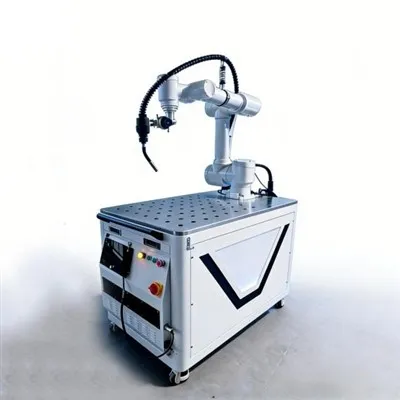
Collaborative Welding Robot If you’re in the market for industrial robots and want to learn more about which communication interfaces would be best for your specific needs, or if you’re just interested in having a chat about our products, don’t hesitate to reach out to us. We’re here to help you find the perfect industrial robot solution for your business.
References
- "Industrial Communication Technology Handbook" – Mark Ciufo
- "Automation Technology Handbook: Industrial Robots and Programmable Logic Controllers" – Patrick Huelsmann
- Articles from industry magazines such as "Automation World" and "Control Engineering"
Xinweilai Intelligent Technology (Shandong) Co., Ltd.
As one of the most professional industrial robot manufacturers and suppliers in China, we’re featured by quality products and good service. Please rest assured to wholesale bulk customized industrial robot from our factory. For pricelist and quotation, contact us now.
Address: Jinghua Road, Economic and Technical Development Zone, Dezhou City, Shandong Province
E-mail: liujiqing@xinweilaiznkj.com
WebSite: https://www.xinweilaiznkj.com/
