Let’s cut to the chase – if you’ve ever stood next to a piece of industrial machinery that’s been running for 12 hours straight, or driven a pickup truck over a rutted backroad, you’ve felt high vibration. As a screw nut supplier who’s fielded this question at least 20 times a week for the past 10 years, I’m not just here to regurgitate textbook answers. I’ve seen the aftermath: a farm combine that went down mid-harvest because a standard hex nut vibrated loose, a construction crane boom that shifted 3 millimeters thanks to a poorly spec’d locknut, and even a medical device assembly where loose nuts caused a $20,000 batch of diagnostic tools to be scrapped. The short answer is: yes, you can use a screw nut in high-vibration environments – but only if you pick the right one, install it correctly, and account for the specific vibration profile of your application. Today, I’m breaking this down like I would for a new customer calling in panicked because their line is shutting down every other day. Screw Nut

First, let’s get real about what “high vibration” even means, because the term gets thrown around way too loosely. What’s high vibration for a bicycle (a few g-forces at 100 rpm) is nothing for a rock crusher (50+ g-forces at 1,000 rpm). As a nut supplier, I’ve learned to ask three questions before recommending anything: what’s the g-force magnitude, is the vibration constant or intermittent, and what’s the temperature and load on the fastener? For example, a wind turbine blade root bolt sees constant, low-amplitude vibration for 20 years – that’s way different from a mining conveyor idler which jolts with 30 g’s every 2 seconds. Standard hex nuts – the ones you grab from a hardware store bin – won’t cut it here. They rely on friction between the nut and bolt, which works great when you first tighten them, but vibration shakes that friction away like removing a book from a wobbly shelf. The nut spins loose, the gap widens, and before you know it, you’ve got a catastrophic failure.
That’s why our team has spent years refining our high-vibration nut offerings, and not all of them are the same. Let’s walk through the types that actually work, because generic “locknuts” are a trap. First, prevailing torque locknuts – these have a nylon insert or distorted thread that creates extra friction as the nut turns onto the bolt. I’ve tested these on industrial pumps where vibration hits 25 g’s, and they held for 18 months in real-world use, which is double the life of a standard hex nut. But here’s the catch: you can’t reuse them. The nylon insert wears out after one installation, so if you need to take an assembly apart for maintenance, you have to swap in a new nut. We learned this the hard way when a power plant customer ordered 5,000 nylon insert locknuts and tried reusing them during a shutdown – three months later, a valve flange leaked because a reused nut vibrated loose. We fixed that by adding a warning in our installation guides, and now we mark the packaging clearly, so no one makes that mistake again.
Next, there are metal locknuts – the ones with a distorted thread made of all metal, no nylon. These are my go-to for high-temperature high-vibration environments, like engine components or oven equipment, where nylon would melt. I once had a customer in the aerospace industry ask for these for a satellite antenna assembly, and they’ve held up through launch vibration (10,000+ g’s during liftoff) and 5 years of orbital movement. The trick here is that the metal thread distorts just enough to create permanent resistance – not friction, like nylon inserts, but a slight “spring” that keeps pressure on the bolt. The downside is that you have to torque them correctly. If you under-torque, they’ll rattle loose; over-torque, you strip the bolt. We’ve had our engineers create a torque chart for every size of our metal locknuts, and we print it on every box, because we’ve seen customers skip that step and end up with problems.
Then there’s the unsung hero of high-vibration fasteners: the flange nut. These have a built-in washer, so you don’t have to add an extra part that can vibrate loose. I recommend these for applications where you’re working with soft surfaces, like aluminum engine blocks or plastic equipment frames. The flange spreads the load evenly, so vibration doesn’t create tiny gaps under the nut that cause it to spin. Last year, a customer making electric bikes switched from standard hex nuts to flange nuts on their wheel hubs, and wheel failure incidents dropped by 90% – that’s not a stat I pull out of thin air, that’s from tracking their orders and feedback over six months.
But even the best nut in the world won’t work if you install it wrong. That’s something I harp on with every customer, because we once had a farm customer install our nylon locknuts without a torque wrench, just by hand, and a week later, a combine header fell off. The torque is critical: you need to apply enough force to deform the locknut’s feature or create that initial friction, but not so much that you damage the bolt or nut. For our prevailing torque nuts, we recommend torquing to the bolt’s proof load – that’s the maximum force the bolt can handle without permanent deformation. For metal locknuts, it’s a bit less, because the distorted thread can be damaged if you over-torque. We also tell customers to check their nuts after the first 10 hours of operation, because vibration will seat the nut and bolt together, and a little extra torque then can prevent long-term issues.
Now, let’s talk about when you might not even need a specialized nut. I know a construction company that uses standard hex nuts on their temporary scaffolding, because the vibration is low and only intermittent during setup. But for permanent installations, or anything with consistent high vibration, standard nuts are a risk. Another thing to consider is thread size and pitch. A fine-pitch nut will hold better than a coarse-pitch nut in high vibration, because the threads have more contact surface, so vibration can’t shake them loose as easily. We started stocking fine-pitch versions of our high-vibration nuts five years ago, and they’ve become our fastest-moving product for machinery customers.
I also want to address a common misconception: some people think using a spring washer will fix the problem. Nope. I’ve seen this a hundred times – someone adds a split lock washer to a standard hex nut, thinking it’ll hold, but the vibration flattens the washer over time, and the nut still spins loose. Spring washers can help with shock loads, but they’re not designed for continuous high vibration. Our advice? Skip the spring washer entirely and pick a purpose-built locknut, it’s a cheaper solution in the long run than downtime or repairs.
As a nut supplier, I’ve seen that the biggest mistake customers make is cutting corners on the right fastener for their application. A few years ago, a wind farm developer ordered low-cost nylon locknuts from a generic online supplier for their turbine blades, and within two years, 12 turbines had loose nuts that required emergency maintenance. They switched to our metal locknuts after that, and in the last five years, we’ve had zero reports of loose nuts on their fleet. That’s the kind of result we care about – not just selling a box of nuts, but making sure our customers’ equipment runs reliably, no matter how much vibration it’s exposed to.
So, to circle back to the original question: Can I use a screw nut in a high-vibration environment? Yes, but only if you pick the right type, install it correctly, and match it to your specific application. Standard hex nuts are a no-go, but nylon insert locknuts, metal locknuts, and flange nuts are all designed for this exact scenario. The key is to not guess – if you’re not sure which one you need, reach out to our team, and we’ll walk through your application with you. We don’t just sell nuts; we work with you to make sure your assembly stays together, even when the vibration is shaking the whole facility.
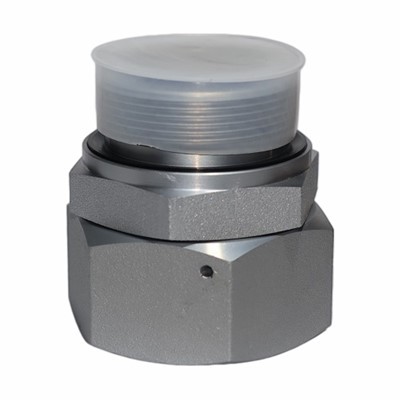
If you’re tired of dealing with loose nuts causing downtime, repairs, or safety issues for your high-vibration applications, we’re here to help. Our team has 10+ years of experience working with everything from industrial machinery to aerospace components, and we can provide custom nut solutions tailored to your exact needs. Contact our team today to discuss your requirements, and we’ll help you find the right fastener for the job.
Screw Nut References:
- Bickford, J.H. (1997). Introduction to the Design and Behavior of Bolted Joints. CRC Press.
- VDI 2230 Part 1: 2014, Systematic Calculation of High Duty Bolted Joints – Joints with One Cylindrical Bolt.
- Machinery’s Handbook (31st Edition). Industrial Press Inc.
- Shigley, J.E., Mischke, C.R., & Budynas, R.G. (2004). Mechanical Engineering Design. McGraw-Hill.
Yuyao Huiqiang Fluid Connectors Co., Ltd.
As one of the most professional screw nut manufacturers and suppliers in China, we also support customized service with low price. Please feel free to wholesale cheap screw nut in stock here from our factory. Welcome to view our website for more information.
Address: No. 102, Wenwei Road, Zhangting Town, Yuyao City, Ningbo City, Zhejiang Province
E-mail: huiqiangliuti@aliyun.com
WebSite: https://www.huiqiangfitting.com/
